

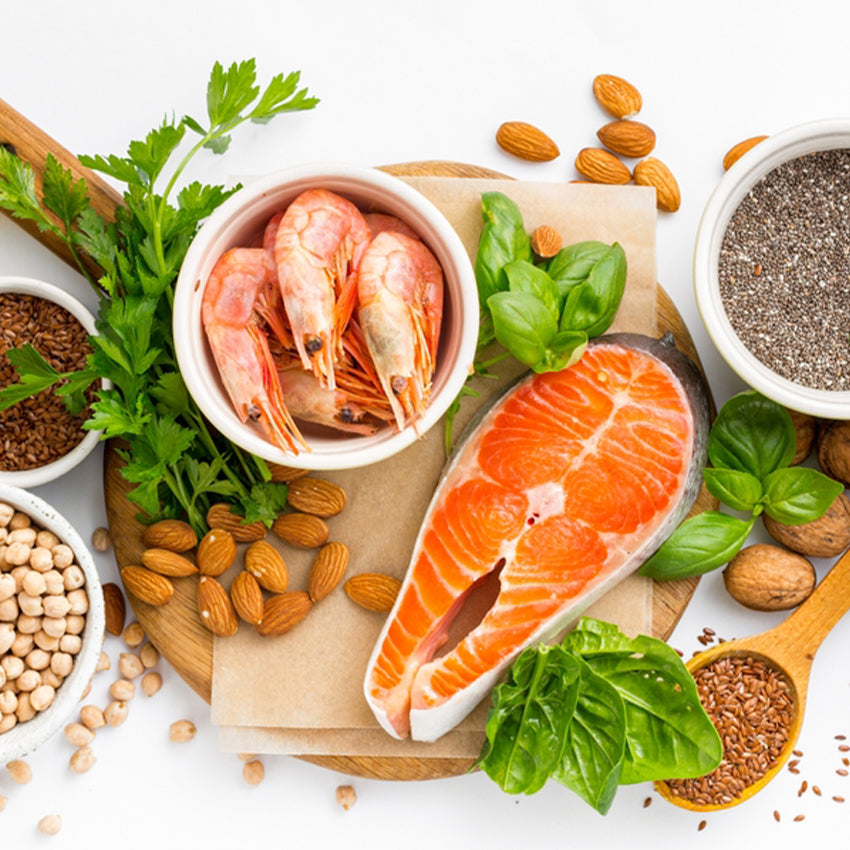
In the last decade, the topic of "Omegas" has been a trend in various media outlets dedicated to nutrition and health. A countless number of properties and health benefits have been attributed to them, and their consumption has been promoted to the point that they are one of the most consumed dietary supplements worldwide, sometimes indiscriminately. Precisely in this article, we want to tell you what they really are, what they are, where we can find them, and what Omega fatty acids are actually used for in health.
- We will start by explaining: What are Omega fatty acids and where can they be found?
These are nothing more than certain types of fat that have beneficial properties for health, provided they are ingested in the appropriate quantity and proportion. This group includes Omega 3, 6, and 9. Of these, 3 and 6 are polyunsaturated and essential, meaning the body is unable to produce them on its own and we must ingest them through diet, unlike 9, which is monounsaturated and non-essential since the body can produce it, though this does not mean its consumption is not beneficial. On this occasion, we will focus on the essential ones, which are part of the structure of the body's cells.
Omega 3: these are divided into 3: EPA (eicosapentaenoic acid), DHA (docosahexaenoic acid), and ALA (alpha-linolenic acid). The first two have been studied more extensively and associated with health benefits. In general, we can find them in foods such as: fatty fish, including salmon, sardines, tuna, herring, and mackerel; also in canola, soybean, and walnut oils, flaxseeds, chia seeds, and nuts. They have been credited with the ability to reduce inflammation, and thus the ability to decrease the risk of contracting various diseases, mainly of a chronic nature.
Omega 6: they are also divided into 3: LA (linoleic acid), ARA (arachidonic acid), and GLA (gamma-linolenic acid). In general, we find them in foods such as: red meat, eggs, dairy products, as well as soybean, corn, safflower, and sunflower oils. These can contribute to improving the lipid profile if accompanied by a healthy lifestyle; however, their consumption should be moderate, as excess has been associated with increased levels of inflammation and pain, as well as a higher risk of contracting chronic and inflammatory diseases.
- So, are Omega 6s harmful?
No. As long as they are consumed in appropriate amounts. It turns out that in the diet of Western countries like ours, the consumption of Omega 6 is about 20 times higher than that of Omega 3, a situation in which the ideal balance that should exist between both is completely lost, and what is worse, this excess comes mostly from highly processed and unhealthy vegetable oils. This ratio is harmful, as both types of fatty acids compete within the body, so the consumption of Omega 6 should be much lower, seeking to maintain a certain balance between the two. This largely explains why there is a much higher prevalence of chronic and inflammatory diseases in the Western hemisphere of the planet, such as those we mentioned previously.
- How do I know how much Omega 3 and 6 I should consume?
Organizations and experts worldwide differ on what the precise ratio between both types of Omegas should be; however, most agree that there must be a balance in the consumption of both, avoiding excesses, mainly of Omega 6, so that its inflammatory potential does not exceed the anti-inflammatory power of Omega 3.
This translates into the following practical recommendations:
- Consume 2 servings of fish per week, equivalent to 300 – 500 mg/day of Omega 3.
- For patients with heart disease, consume double that, equivalent to 1000 mg/day of Omega 3.
- If you cannot consume that amount of fish as a primary source of Omega 3, opt for other mentioned foods or for supplementation ALWAYS under the advice of a professional familiar with your case.
- In case of taking Omega 3 supplements, try not to do so in excessive doses or for very prolonged periods, as it could have adverse effects on your health.
- Avoid excessive consumption of foods high in vegetable oils, fast foods, and fried foods.
- Prepare your food using cooking methods that do not use oil, or use it in small quantities.
- Opt for consuming vegetables fresh or steamed.
- Prefer to consume fresh, whole foods over those that are highly processed, preserved, and refined.
Camila Henao
Registered Dietitian
University of Antioquia