

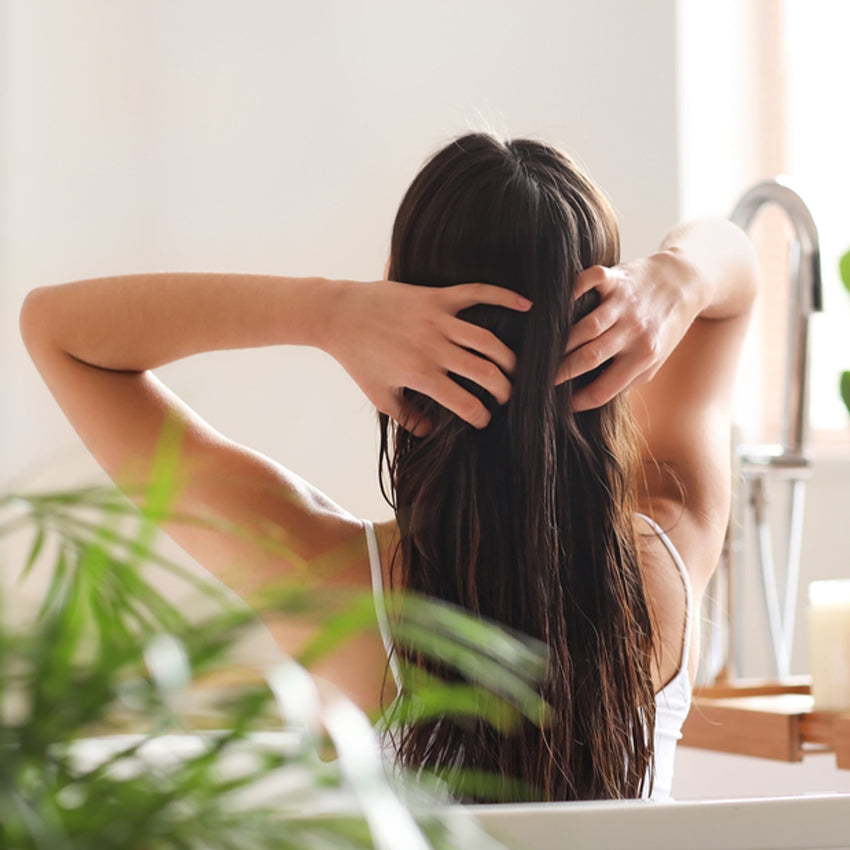
Hair care tips
Often, the shape and texture of our hair changes without us really knowing the reasons why. Perhaps a change in products, routine, hormonal shifts, or exposure to high levels of stress or poor habits can cause our hair to suffer. Today we want to share 8 tips you should keep in mind to maintain your hair's health to the fullest.
1) Washing your hair with cold water makes hair look shinier. You don't need to do the entire wash with cold water. We can start with lukewarm water and do the final rinse with colder water. This will help make the hair shine more.
2) You should not go to bed with wet hair. If we go to sleep with wet hair, we can damage the scalp cuticle, leading to irritations that will later cause discomfort.
3) Washing your hair every day is not recommended, and if you do, you should use appropriate products for its care.
4) Washing it rarely or not washing it at all is not good. All hair needs to be washed every so often. No hair can look beautiful and healthy if washed too infrequently.
5) Follow a moisturizing care routine once a week, and use shampoo according to your hair type and scalp needs, for example, using products to prevent hair loss or dandruff, among others.
6) It is recommended to detangle hair when it is wet. The best time to detangle is right after getting out of the shower, since at that moment the hair is much more flexible because it is damp, and by "pulling" on it, we damage it less than when it is dry.
7) Dandruff does not promote hair loss. We know that the sebaceous gland and the hair follicle are together, but they are two phenomena that have nothing to do with each other.
8) Washing your hair a lot does not cause it to fall out more. The hairs that fall out when washed are "old" hairs that are lost due to any trauma that healthy hair would resist. Every day, an average of 50 hairs shed and then grow back in the same spot, so the total number of hairs will always remain constant.
Hair types: Discover your hair type and identify its texture.
Type 1: straight hair
Type 1A: This is fine hair that tangles more easily due to its structure.
Type 1B: A mix between fine hair and hair with more "hold," thicker.
Type 1C: Thicker hair, more resistant to curls (the famous "heavy straight hair") and "shinier" than other types, due to the sebum on the scalp, which can reach the ends more easily.
Type 2: wavy hair
Type 2A: Fine hair with a slight S-shaped wave in the lengths, leaving the wavy pattern of the hair more undefined and with little volume.
Type 2B: Hair with slightly more defined S-shaped curls, which may show slight frizz at the scalp.
Type 2C: Thicker hair, very voluminous, and with well-defined S-shaped curls.
Type 3: curly hair
Type 3A: Hair with larger curls. This is the most hydrated of the three, and the heaviest, which explains the slight loss of curl definition. In some cases, the roots may be straight due to the weight.
Type 3B: Hair with S-shaped curls, more wavy at the roots, with well-defined, tighter curls than the previous type.
Type 3C: There is no consensus on the definition of type 3C. It is characterized by well-defined and tight, or "small," curls that can form from the root. Some consider this hair type curly, while others consider it coily.
Type 4: coily hair
Type 4A: Hair tightly coiled from the root, very voluminous, with a spiral wave, and a slightly defined shape.
Type 4B: Hair tightly coiled and wavy in an S-shape, which can be a bit finer, denser, and sometimes fragile.
Type 4C: Thinner and more fragile hair, with Z-shaped curls that don't really form curls. It may look "heavy" due to the tight coils, but make no mistake: this is the most fragile hair of the three.
By: Indira Victoria González Rodríguez.
Nutritionist Dietitian UCV. – Line specialist for Laboratorios Funat.