

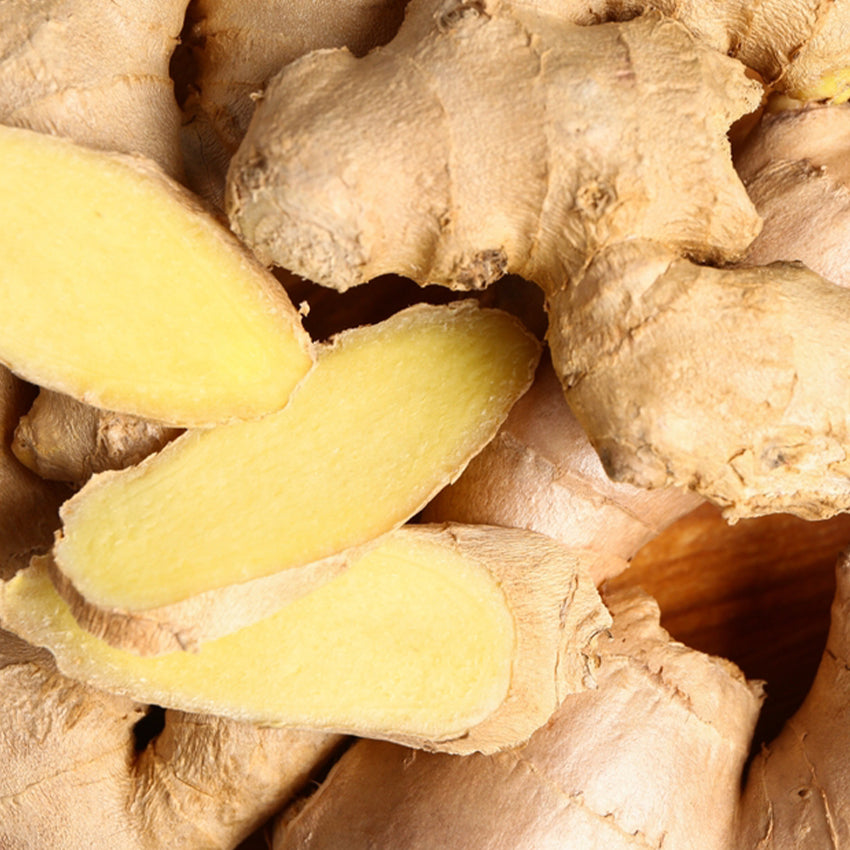
What is ginger?
Ginger is a root identified by the scientific name Zingiber officinale Roscoe. It originates from South Asia, specifically China and parts of India, which subsequently spread to Greece, Rome, and Arabia, and much later arrived in the Western world.
The part of ginger that has various applications and uses is its rhizome, which has a strong and aromatic odor, a sour to pungent taste, and is ash-colored on the outside and ivory on the inside.
In addition to being widely used in gastronomy for its great sensory attributes, this plant is one of the most popular in traditional Chinese medicine, where this root is known as Jiang, which in their language means "to defend"; it is not for nothing that this plant is useful for treating and supporting treatments for various health conditions.
What is ginger used for?
Below, we tell you about some of the properties of ginger and explain in which cases you can use it for therapeutic purposes:
Use No. 1: It contributes to the relief of motion sickness symptoms. This condition is also known as "kinetosis" and refers to the typical discomfort we feel when traveling by car, plane, or boat. It is also useful for preventing nausea and even vomiting. As a curious fact, its action against motion sickness is exerted on the digestive tract and not at the level of the central nervous system, which represents a great advantage over antihistamine drugs, traditionally used to prevent it, which generally generate strong drowsiness. Unlike these, ginger does not cause sleepiness. (1) Regarding the use of ginger for pregnant women, it is considered safe; even the World Health Organization (WHO) has stated the following: “To relieve nausea in the early stages of pregnancy, ginger, chamomile, vitamin B6, or acupuncture are recommended, depending on the woman's preferences and the available options.” (2)
Use No. 2: It helps relieve symptoms of gastrointestinal conditions and disorders such as mild spasms, bloating, and flatulence, that is, gas production. Ginger has been traditionally considered a digestive plant, and this is because its antispasmodic and antiemetic properties lie in its pungent components.
Use No. 3: It acts as an expectorant and is useful in the treatment of colds and flus. An expectorant is the ideal treatment for the type of productive cough, that is, one that presents phlegm and bronchial secretions, which is characteristic of flu or common cold conditions; the opposite of a dry cough.
By being an expectorant, it promotes the expulsion of bronchial secretions. To achieve the desired effect with this and any other expectorant, it is recommended to ensure a good intake of liquids, and if it does not improve, it is suggested to visit a doctor.
It is recommended to avoid the consumption of ginger in people who suffer from peptic ulcers or gastritis.
Bibliographic references consulted: http://dspace.ucacue.edu.ec/bitstream/reducacue/6543/1/Estudio%20de%20las%20apliciones%20terap%C3%A9uticas%20del%20jengibre.pdf https://apps.who.int/iris/bitstream/handle/10665/250802/WHO-RHR-16.12-spa.pdf;jsessionid=FF393D0AF2A8159AB376AC4C1400CBDB?sequence=1
By: Camila Henao Uribe
Nutritionist Dietitian– Funat Laboratories